

Sunday Sermonettes #095
Isn’t he the Carpenter? That was how the people saw him.
There is something that touches us here. The Son of God lived a common life as a working class man in an obscure town called Nazareth.
Jesus had brothers and sisters. And the people knew their family. So Jesus was also familiar with all that happens in families, the joys and sorrows, the irritations and good moments too.
Though people accused him that he equated himself with God and tried to stone him for calling God, Father; we don’t have any record of anyone accusing him of lazy, dishonest, or poorly done wood work.
He shaped wood to make furniture. And the only time he couldn’t do that with wood was when he was nailed to the tree.
He earned a living for his family through the sweat of his toil. Yet he sweated blood when he came near the agony of the cross.
The Carpenter understands a lot more of your life than you think.
He is willing to shoulder your worries and anxieties. Sometimes he seems to have forsaken you. That feeling is real. He too cried out on the cross, “My God, my God, why have you forsaken me?”
That was real to him. Therefore the Carpenter knows what it feels when you feel absolutely helplessly lost.
We can be sure the Carpenter knew his tools and what he was making. Perhaps he is making something of you.
It might not lessen your pain. But isn’t there something about the Carpenter that makes you trust?
Bible References:
“The beginning of the gospel of Jesus Christ, the Son of God.” — Mark 1:1 (NIV 1984)
“Isn’t this the carpenter? Isn’t this Mary’s son and the brother of James, Joseph, Judas and Simon? Aren’t his sisters here with us?” And they took offense at him.” — Mark 6:3 (NIV 1984)
And at three in the afternoon Jesus cried out in a loud voice, Eloi, Eloi, lema sabachthani? (which means My God, my God, why have you forsaken me?). — Mark 15:34 (NIV 1984)
A Word About the Gospel of Mark:
Written for a Roman audience obsessed with power, Mark’s Gospel is a fast-paced, action-packed narrative that reveals the ultimate authority of Jesus through His radical role as a suffering Servant.
Featured image courtesy: Ismael_Campos on Pixabay
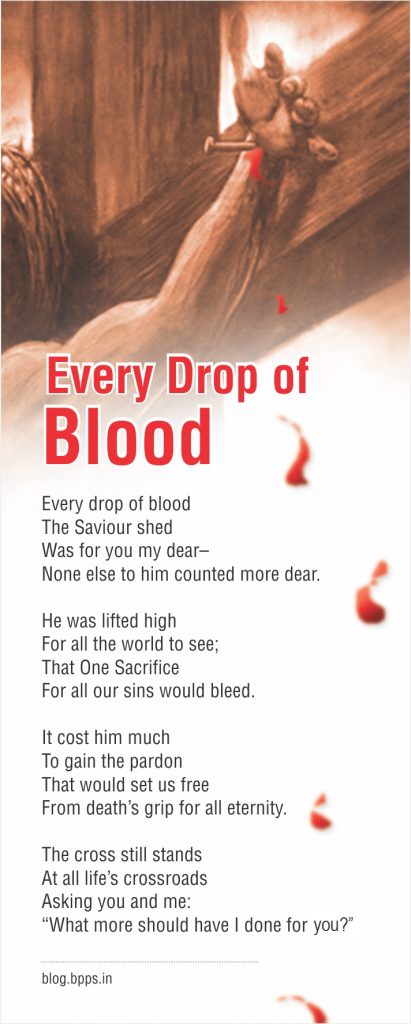
Every Drop of Blood
Would You Be Free from the Burden of Sin